Translate this site into your preferred language, look for our Google translator in our home page: diningwithjesus.net
Traduce este sitio en tu idioma preferido, busca nuestro traductor de Google en nuestra página de inicio ve a: diningwithjesus.net
Pastor Chris White says to all of you: HELLO MY FRIENDS. May the Lord bless you today.
HOLA MIS AMIGOS. Que el Señor los bendiga.
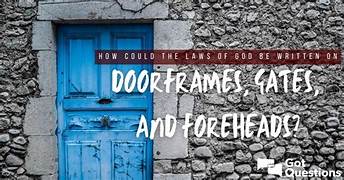
In Deuteronomy 6:8–9 the Lord speaks of His laws, saying, “Tie them as symbols on your hands and bind them on your foreheads. Write them on the doorframes of your houses and on your gates.” A related passage says, “Fix these words of mine in your hearts and minds; tie them as symbols on your hands and bind them on your foreheads. Teach them to your children, talking about them when you sit at home and when you walk along the road, when you lie down and when you get up. Write them on the doorframes of your houses and on your gates” (Deuteronomy 11:18–20). Write them on the doorframes, tie them on your hands, and bind them on your foreheads. Were the Jewish people to take these commands literally?
Doors and Gates: The Jewish tradition of placing a mezuzah on the doorpost is based on this passage of Scripture. The mezuzah (the Hebrew word for “doorpost”) is a small piece of parchment usually containing this line from Deuteronomy 6:4: “Hear, O Israel: The Lord our God, the Lord is one.” An extra-biblical Jewish tradition requires that these words be written by an approved Jewish scribe called a sofer stam. The parchment is folded or rolled, placed in a small case, and attached to the right side of the doorway of a home at shoulder height. Tradition dictates that it be placed within 30 days of moving into a new home.
Foreheads/Hands: Since ancient times, Jews have practiced the tradition of using phylacteries (also called “tefillin”). Phylacteries are small leather boxes that contain portions of the Law of Moses. The boxes are strapped to the wrist and to a sort of headband so that one literally carries the laws of God over his eyes and on his hands. Jesus mentions this practice in Matthew 23:5: “They make their phylacteries wide.”
Despite the literal application of these verses by traditional Jews, many Old Testament scholars believe the commands were meant to be figurative. Exodus 13:9 and 16 also suggest God was using figurative language to emphasize the importance of obeying His laws. Later prophets argued that the emphasis of the Law was on matters of the heart rather than external ritual. Micah, for example, noted, “He has shown you, O mortal, what is good. And what does the LORD require of you? To act justly and to love mercy and to walk humbly with your God” (Micah 6:8).
In summary, many Jews have taken the concept of putting God’s laws on doors, hands, and head literally, yet the emphasis in these passages is on the importance of the Law. The Law of the Lord is perfect, according to Psalm 19:7. Psalm 1 emphasizes the importance of meditating upon God’s Word both day and night. We should never forget it; it should be a part of our daily lives. The Word belongs in our hearts, not just on our foreheads.
Get new content delivered directly to your inbox. Please Enter your email address in the box below.
Thank you to Got Questions© Copyright 2002-2025 Got Questions Ministries. All rights reserved.


 DINING WITH JESUS PRODUCTIONS
You must be logged in to post a comment.